The lovely winged jewels we call butterflies are the pioneering and reproductive life stage of an insect that goes through 3 other distinct stages: eggs, larvae (caterpillars), and pupae (chrysalids). The adult stage, the butterfly, is technically called the imago. About eighty percent of all insects are holometabolus, which is a way of partitioning resources, so that each life stage does not compete with any other. Your habitat garden needs to provide for the needs of every life stage in order for there to be butterflies.
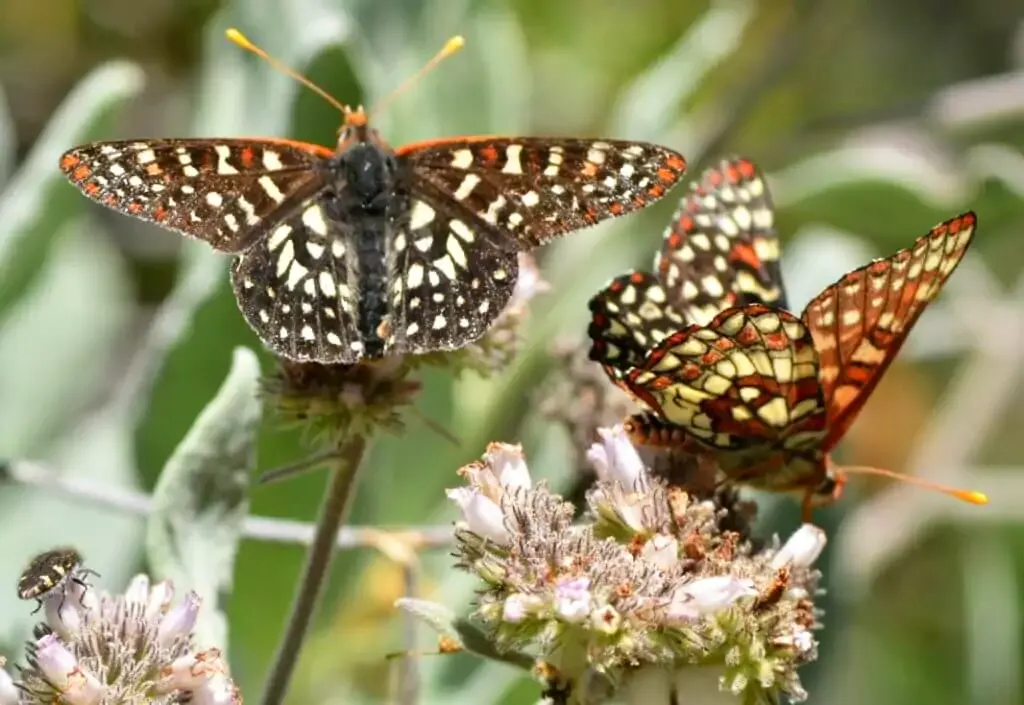
Variable checkerspot butterflies need nectar for food while they search for the appropriate host plant to lay their eggs on. Photo: Marc Kummel
The purpose of a butterfly’s often short life “on the wing” is simply to find a mate and the host plant on which to lay the eggs of the next generation. They will be looking for the plant that their hatched larvae will eat; many butterfly species are extremely choosy about what plant that is. The adult butterfly will need nectar for energy as she hunts for her special host plant. If you are interested in attracting a specific type of butterfly, check the handout at right, Butterfly Larval Host Plants, to learn some of the appropriate plants.
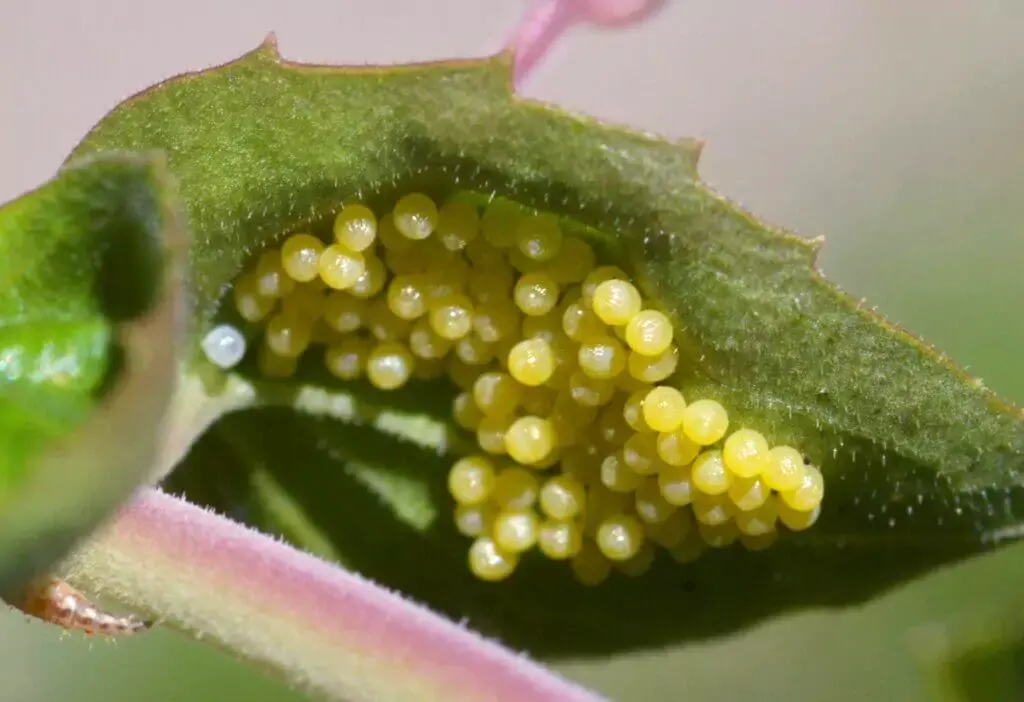
Butterflies will often deposit their eggs on the underside of a leaf where they are more protected. Photo: Marc Kummel
To get a good indication of which butterfly species are already present in the general area of your garden, start with specimens of flowering plants that are noted as really good nectar sources, and then observe the butterflies that come into your garden to feed. Buddleias, verbenas, and lantana, though not native, bloom for a long period of time and are loved by butterflies. Flowers in the composite family (aster, sunflower, or daisy), offer a landing pad when fully opened, which is important for the larger butterflies like the Monarchs. Flowers in the composite family are composed of hundreds of individual disc flowers, and petal flowers, and each of these tiny flowers provides nectar and pollen, thus providing a lot of food energy in one place! If you can, allow ”managed” populations of weeds such as Italian thistle, English plantain, and cudweeds, which are favored larval host plants of some beautiful butterfly species.
Butterflies are not important pollinators of plants, but their beauty certainly adds to the charm of any garden!
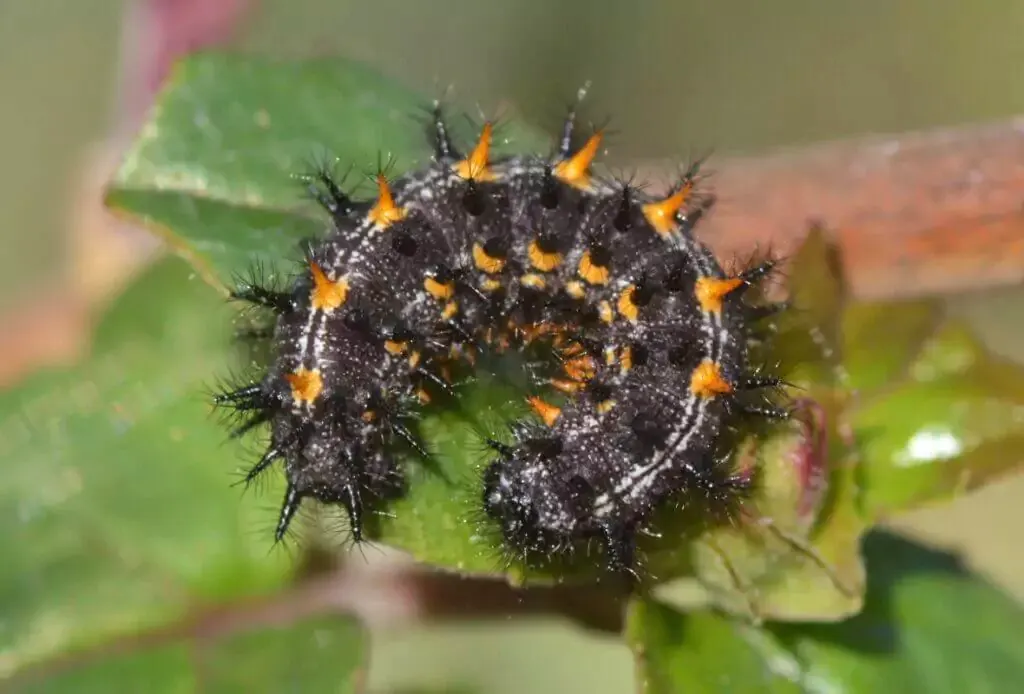
Caterpillars will consume several plants but their principal host plant is sticky monkeyflower. Photo: Marc Kummel
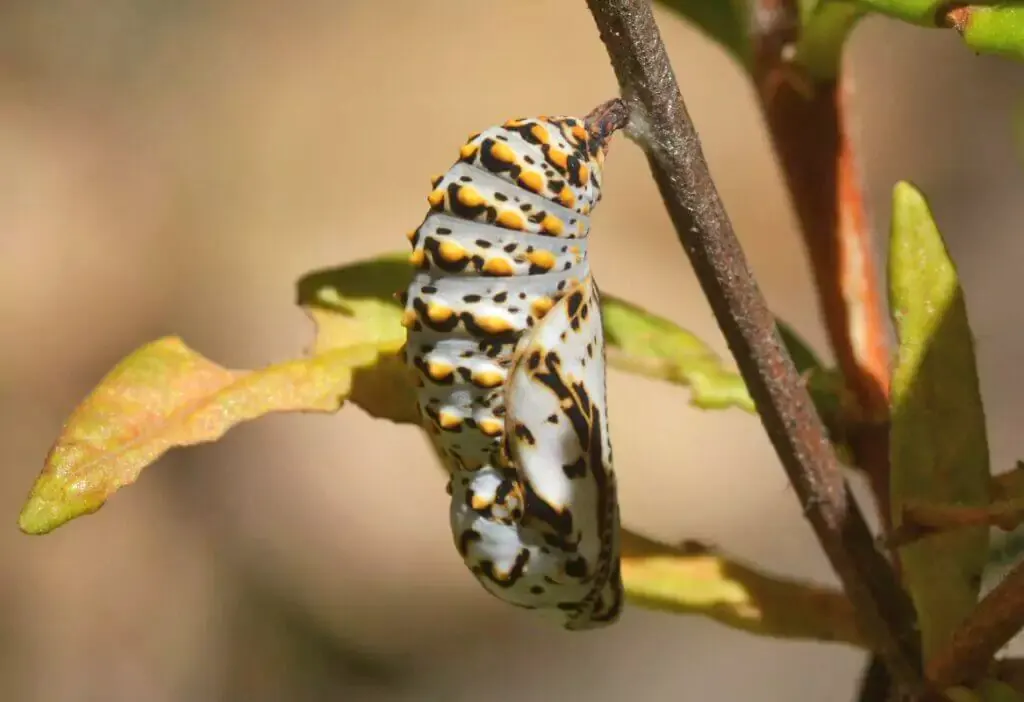
An adult butterfly will emerge from the chrysalis formed by the caterpillar. Photo: Marc Kummel
Recommended Reading
Butterflies
Butterflies through Binoculars: The West
Jeffrey Glassberg; Oxford Univ. Press2001
California Butterflies
John Garth and J. W. Tilden; UC Press1988
Caterpillars in the Field and Garden
Allen, Brock and Glassberg; Oxford Univ. Press2005
Chasing Monarchs: Migrating with the Butterflies of Passage
Robert Michael Pyle; Yale University Press 2014Common Butterflies of California
Bob Stewart; West Coast Lady Press 1997Field Guide to Butterflies of the San Francisco Bay and Sacramento Valley Regions
A. Shapiro and T. Manolis; UC Press 2007Truly specific to our region with lots of details on local species. The book also has good introductory information on butterflies, life histories, how to raise caterpillars, and local plants.
Four Wings and a Prayer: Caught in the Mystery of the Monarch Butterfly
Sue Halpern; Vintage 2002Mariposa Road: The First Big Butterfly Year
R. M. Pyle; Yale University Press 2013A tale about finding as many butterfly species as feasible in one year.
Milkweeds, Monarchs and More, 2nd Ed.
Ba Rea, Karen Oberhauser, and Michael A. Quinn; Bas Relief LLC 2011The Monarch Butterfly: Biology and Conservation
Karen S. Oberhauser and Michael J. Solensky, editors; Comstock Publishing 2004A collection of scientific studies and essays covering breeding, migration, and overwintering biology. Back to Pollinators Waystation